

Project Update: June 2023
Conservation Awareness Campaigns and Sustainable Livelihood Training in Communities Around the Kom-Wum Forest Reserve
On 10 May 2023, PRACOND’s Programme Manager visited communities surrounding the Kom-Wum Forest Reserve in the North West Region of Cameroon to conduct conservation awareness campaigns and sustainable livelihood training workshops.
During the visit, we organised conservation education and beekeeping training workshops for hunters, farmers, children and collectors of non-timber forest products (NTFPs) in the Bu, Mbengkas and Baiso village communities (Figures 1a–b). These activities aimed to raise awareness about biodiversity conservation, promote sustainable natural resource management and encourage alternative livelihood opportunities that reduce dependence on hunting and forest resources.
We also held in-depth discussions with the traditional ruler (Fon) of each village and long-term community residents who had lived in the area for more than ten years (Figures 1c–d). These discussions helped us understand local perspectives on wildlife conservation, strengthen community participation and promote greater awareness of the importance of protecting the Kom-Wum Forest Reserve and its biodiversity.
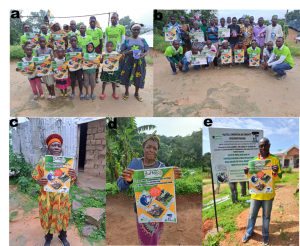
Figure 1: Conservation education workshops involving children, farmers and hunters in Mbengkas village (a and b), and conservation awareness discussions with the Fon of Mbengkas village (c) and key community members of Bu village (d and e).
Promoting Sustainable Livelihoods Through Community Beekeeping
As part of our efforts to reduce hunting pressure on threatened wildlife in the Kom-Wum Forest Reserve, we organised practical beekeeping workshops for hunters and farmers in Bu, Mbengkas and Baiso villages. Participants received hands-on training in constructing Kenyan top-bar beehives (Figure 2a and b), introducing a beekeeping technique that was not widely practised in these communities.
We trained 95 community members, including 22 hunters and 73 farmers, across the three villages. Of these, 43 participants (10 hunters and 33 farmers) came from Bu, 32 (8 hunters and 24 farmers) from Mbengkas, and 20 (4 hunters and 16 farmers) from Baiso.
To encourage the adoption of beekeeping as a sustainable alternative livelihood, we provided four protective bee suits and three smokers for collective use by the trained beekeepers (Figure 2c). These resources were intended to support continued beekeeping activities and reduce dependence on hunting and other activities that threaten wildlife.
We also established a chimpanzee conservation club and a beekeepers’ association in each village. The conservation clubs, comprising mainly hunters, aimed to strengthen local participation in protecting chimpanzees and other threatened wildlife. In addition, we distributed T-shirts bearing conservation messages discouraging chimpanzee hunting and bushmeat consumption.
To strengthen community ownership and ensure the long-term sustainability of these initiatives, we established three Community Initiative Groups (CIGs), one in each village, bringing together hunters and beekeepers. These groups were established to coordinate community-led conservation and livelihood activities, with registration in Wum planned before December 2023.
Through these initiatives, PRACOND seeks to strengthen the link between biodiversity conservation and sustainable livelihoods by empowering local communities to participate actively in protecting the Kom-Wum Forest Reserve and its threatened wildlife.
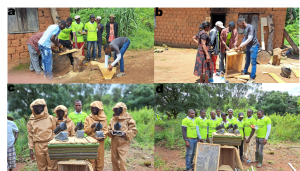
Figure 2: PRACOND’s Programme Manager providing practical training to hunters (a) and farmers (b) on the construction of Kenyan top-bar beehives in Baiso village, and distributing protective bee suits and smokers to beekeepers (c) and hunters (d) in Bu village.
The Chimpanzees of Kom-Wum Forest Reserve, Cameroon
Kom-Wum Forest Reserve, covering approximately 92 km² in the North-West Region of Cameroon, provides an important habitat for the Endangered Nigeria-Cameroon chimpanzee (Pan troglodytes ellioti), one of Africa’s rarest and least-studied chimpanzee subspecies. Previous ecological surveys conducted between 2018 and 2023 estimated approximately 83 chimpanzees in the surveyed forest area.
Research conducted by Fotang et al. (2021) revealed that chimpanzees preferentially use mature forests, where researchers recorded an average of 2.3 chimpanzee signs per kilometre, compared with 0.3 signs per kilometre in secondary forests. Conversely, human activities were more frequent in secondary forests (8.0 signs/km) than in mature forests (0.9 signs/km). Chimpanzee activity was also greater at higher elevations, particularly above 1,000 metres. These findings highlight the importance of protecting mature forests and reducing human disturbance.
Further ecological studies documented chimpanzee tree and ground nesting behaviour, feeding ecology and habitat preferences. Fruits constitute a major component of their diet, emphasising the importance of conserving fruit-bearing trees and suitable nesting habitats.
Despite its ecological importance, Kom-Wum Forest Reserve faces threats from poaching, illegal logging, agricultural expansion, livestock grazing and forest degradation. These activities threaten chimpanzee survival and the ecological integrity of the reserve.
To address these threats, PRACOND works with local communities and conservation partners to strengthen anti-poaching patrols, monitor chimpanzees and other threatened wildlife, promote sustainable livelihoods through beekeeping and pig farming, conduct conservation education and restore degraded forest habitats.
By integrating scientific research, community participation and sustainable livelihood development, PRACOND aims to protect the Nigeria-Cameroon chimpanzee and conserve the biodiversity of Kom-Wum Forest Reserve for future generations.
Sources and Scientific Publications
1. Human Activities and Forest Degradation
Fotang, C., et al. (2021). Human activity and forest degradation threaten populations of the Nigeria-Cameroon chimpanzee (Pan troglodytes ellioti) in Western Cameroon. International Journal of Primatology, 42, 105–129.
2. Chimpanzee Nesting Ecology
Fotang, C., et al. (2021). Environmental and anthropogenic effects on the nesting patterns of Nigeria-Cameroon chimpanzees in North-West Cameroon. American Journal of Primatology, 83(9), e23312.
3. PhD Research on Chimpanzee Ecology
Fotang, C. (2023). Conservation Status and Ecology of the Nigeria–Cameroon Chimpanzee in Kom–Wum Forest Reserve, North-West Region, Cameroon. PhD thesis, Brandenburg University of Technology Cottbus–Senftenberg, Germany.
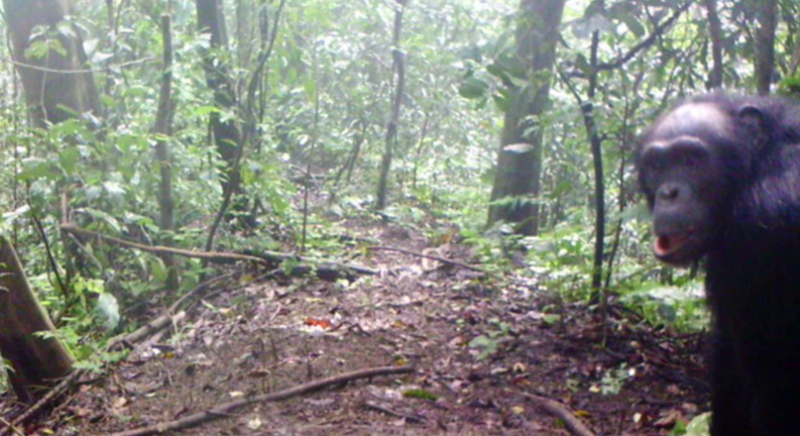
Figure 3: The Nigeria-Cameroon chimpanzee (Pan troglodytes ellioti) in the Kom-Wum Forest Reserve, North-West Region, Cameroon. © Fotang Chefor
The Olive Baboon (Papio anubis)
The olive baboon (Papio anubis) is one of the primate species found in the Kom-Wum Forest Reserve, North-West Region, Cameroon. The International Union for Conservation of Nature (IUCN) classifies the species as Least Concern, reflecting its relatively widespread distribution across sub-Saharan Africa. In Cameroon, the olive baboon is listed under Class C wildlife protection, which regulates its hunting and exploitation. Although the species is not currently considered globally threatened, protecting its habitat and reducing human-induced disturbances remain important for maintaining healthy populations and conserving biodiversity within the reserve.
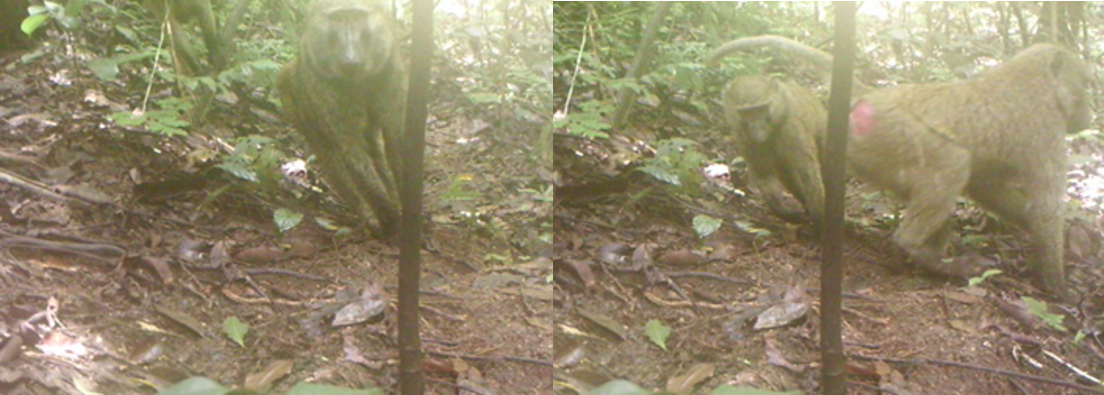
Figure 4: Female olive baboon (Papio anubis) with a juvenile, captured by a camera trap in the Kom-Wum Forest Reserve, North-West Region, Cameroon, in 2018. © Fotang Chefor
The Putty-Nosed Monkey (Cercopithecus nictitans ludio)
During our 2018 wildlife surveys in the Kom-Wum Forest Reserve, North-West Region, Cameroon, we recorded more than 14 groups of putty-nosed monkeys (Cercopithecus nictitans ludio). We frequently observed these monkeys in mixed-species groups with Mona monkeys (Cercopithecus mona). On four separate occasions, we also observed putty-nosed monkeys in association with Nigeria-Cameroon chimpanzees (Pan troglodytes ellioti). These findings highlight the diversity of primates inhabiting the reserve and underscore the importance of conserving their shared forest habitats.
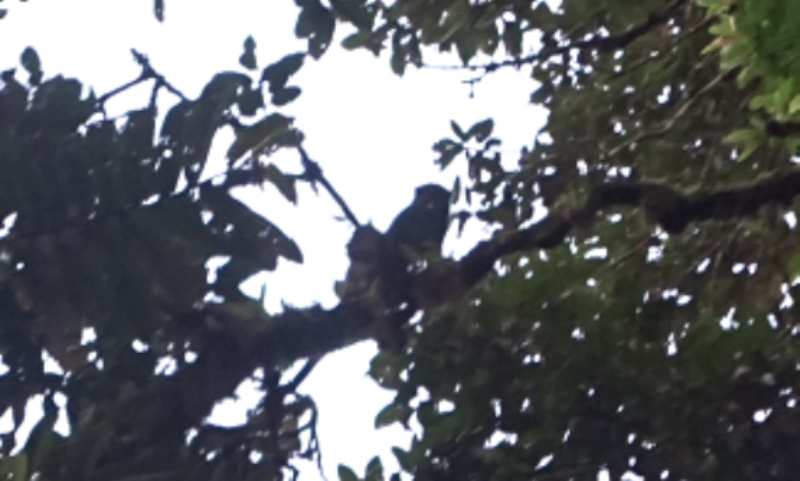
Figure 5: Black-Casqued Hornbill (Ceratogymna atrata) and Great Blue Turaco (Corythaeola cristata)
During our 2018 wildlife surveys in the Kom-Wum Forest Reserve, North-West Region, Cameroon, we confirmed the presence of the black-casqued hornbill (Ceratogymna atrata) and the great blue turaco (Corythaeola cristata). Both species were observed on several occasions, highlighting the reserve’s rich bird diversity and its importance as a habitat for forest-dependent bird species. These findings underscore the need to protect the reserve’s forest habitats and maintain the ecological conditions necessary for the long-term conservation of its avian biodiversity.
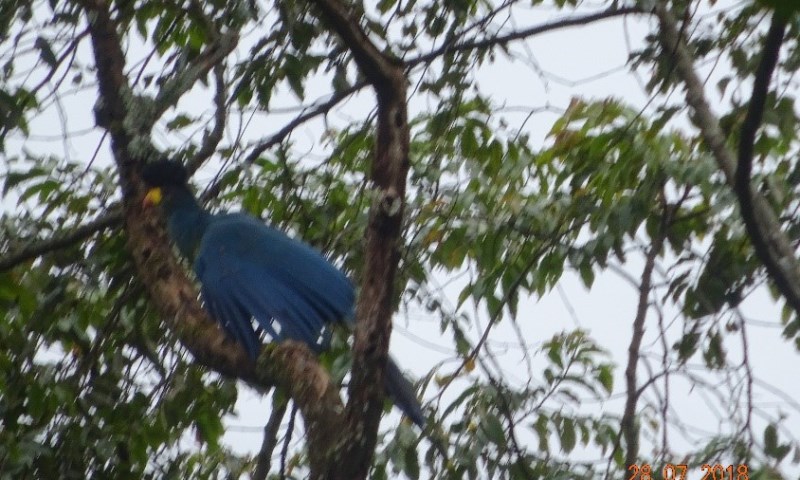
Figure 6: Great blue turaco (Corythaeola cristata) photographed in the Kom-Wum Forest Reserve, North-West Region, Cameroon, in 2018. The species is classified as Least Concern on the IUCN Red List and is listed under Class B (partially protected) in Cameroon. © Fotang Chefor
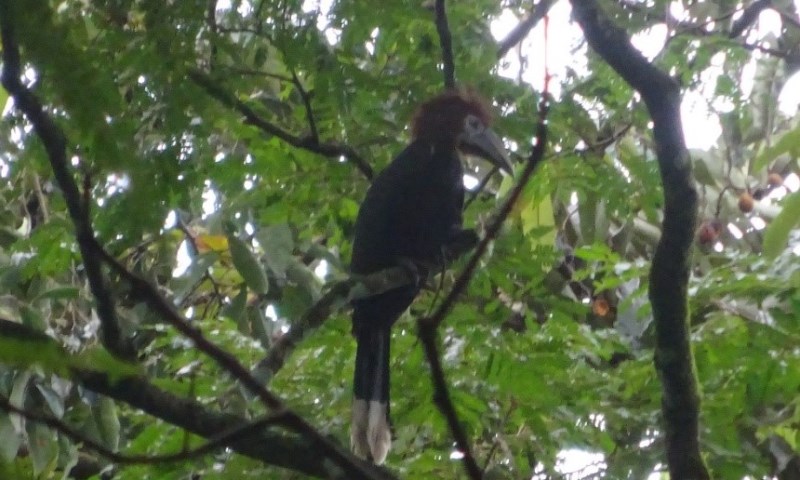
Figure 7: Female black-casqued hornbill (Ceratogymna atrata) photographed in the Kom-Wum Forest Reserve, North-West Region, Cameroon, in 2018. The species is classified as Least Concern (LC) on the IUCN Red List and is listed under Class C wildlife protection in Cameroon. © Fotang Chefor
Nesting Ecology of the Nigeria-Cameroon Chimpanzee in the Kom-Wum Forest Reserve
Our research on the nesting ecology of the Endangered Nigeria-Cameroon chimpanzee (Pan troglodytes ellioti) in the Kom-Wum Forest Reserve, North-West Region, Cameroon, revealed important relationships between chimpanzee nesting behaviour, forest characteristics and human activities.
During our wildlife surveys, which began in 2018, we documented both tree and ground nesting. These included daytime resting nests constructed in trees and on the ground, as well as more than ten ground nests identified as overnight nests during the 2018 surveys. Although chimpanzees generally construct their night nests in trees, these observations demonstrate that ground nesting also occurs in the reserve.
Our broader research recorded 568 chimpanzee nests, providing valuable information on nesting-site selection, habitat preferences and the environmental factors influencing chimpanzee distribution.
As reported in our published study, Environmental and Anthropogenic Effects on the Nesting Patterns of Nigeria-Cameroon Chimpanzees in North-West Cameroon (Fotang et al., 2021), chimpanzee nesting patterns were influenced by both environmental conditions and human activities.
We found that chimpanzees preferentially nested in mature forest habitats, particularly at higher elevations and on slopes. Nesting-site selection was also associated with the availability and characteristics of suitable nesting trees. Important tree species included Strombosia spp., Pseudospondias microcarpa, Monodora myristica and Musanga cecropioides.
Human activities also influenced nesting patterns. Chimpanzees tended to avoid areas close to human settlements and heavily disturbed habitats, highlighting the potential effects of habitat degradation, agricultural expansion and other human disturbances on their nesting behaviour.
The occurrence of ground nests is particularly interesting because it may reflect local habitat conditions, nesting preferences and perceived risks. However, ground nesting alone does not demonstrate that chimpanzees are safer in Kom-Wum than in other forest reserves. Further research is needed to determine the ecological and behavioural factors influencing this nesting strategy.
Conservation Implications
Our findings highlight the importance of protecting mature forests, suitable nesting trees and relatively undisturbed habitats within the Kom-Wum Forest Reserve. They also emphasise the need to reduce illegal hunting, forest degradation and other human activities that threaten chimpanzee habitats.
Through continued wildlife monitoring, community-based anti-poaching patrols, conservation education and habitat restoration, PRACOND aims to strengthen the protection of critical nesting habitats and support the long-term survival of the Nigeria-Cameroon chimpanzee.
Sources and Further Reading
1. PhD Thesis
Fotang, C. (2023). Conservation Status and Ecology of the Nigeria–Cameroon Chimpanzee in Kom–Wum Forest Reserve, North-West Region, Cameroon. PhD thesis, Brandenburg University of Technology Cottbus–Senftenberg, Germany.
2. Published Research on Chimpanzee Nesting Ecology
Fotang, C., Bröring, U., Roos, C., Enoguanbhor, E. C., Dutton, P., Tédonzong, L. R. D., Willie, J., Yuh, Y. G., & Birkhofer, K. (2021). Environmental and anthropogenic effects on the nesting patterns of Nigeria–Cameroon chimpanzees in North-West Cameroon. American Journal of Primatology, 83(9), e23312.
- Read the published research article
- Download the full research paper (PDF)
- Find the article on Google Scholar
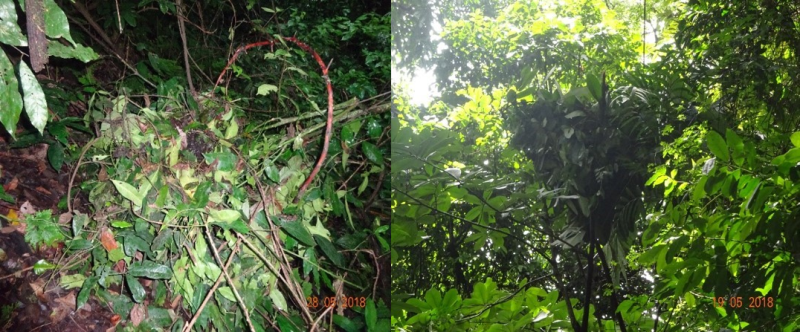
Figure 8: Fresh ground nest(left) and tree nest (right) chimpanzee in Kom-Wum Forest Reserve ©Fotang Chefor.
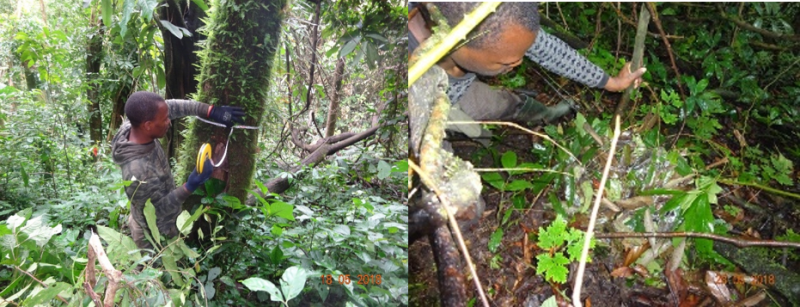
Figure 9: Chimpanzee nesting ecology research in Kom-Wum Forest Reserve, Cameroon. Left: A PRACOND researcher measures the circumference of a tree used for nesting by chimpanzees. Right: The principal investigator examines a chimpanzee ground nest for hair samples as part of ecological research on chimpanzee nesting behaviour.
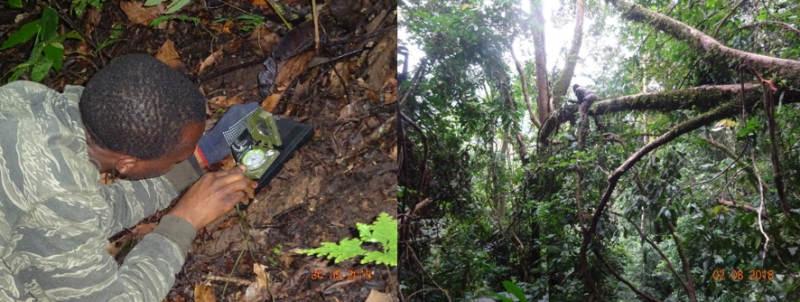
Figure 9: Chimpanzee nesting ecology research in Kom-Wum Forest Reserve, Cameroon. Left: A PRACOND researcher measures the slope of the terrain beneath a chimpanzee nesting tree. Right: A researcher examines a chimpanzee tree nest for hair samples as part of ecological research on chimpanzee nesting behaviour and habitat characteristics.
Diet of the Nigeria-Cameroon Chimpanzee in Kom-Wum Forest Reserve
The Endangered Nigeria-Cameroon chimpanzee (Pan troglodytes ellioti) in Kom-Wum Forest Reserve feeds predominantly on fruits, although its diet also includes other plant materials and animal food sources. In his PhD research, Fotang (2023) analysed 59 chimpanzee faecal samples collected between May 2018 and March 2020 and identified 23 dietary components, including seeds from 15 fruit taxa. Fruits accounted for approximately 98% of the total volume of faecal samples, while plant fibres represented 2%. The study identified Landolphia sp., Pseudospondias macrocarpa and Cyclomorpha solmsii as preferred foods, highlighting the importance of fruit-bearing trees for chimpanzee conservation in the reserve.
Source: Fotang, C. (2023). Conservation Status and Ecology of the Nigeria–Cameroon Chimpanzee in Kom–Wum Forest Reserve, North-West Region, Cameroon. PhD thesis, Brandenburg University of Technology Cottbus–Senftenberg, Germany.
Read the research:
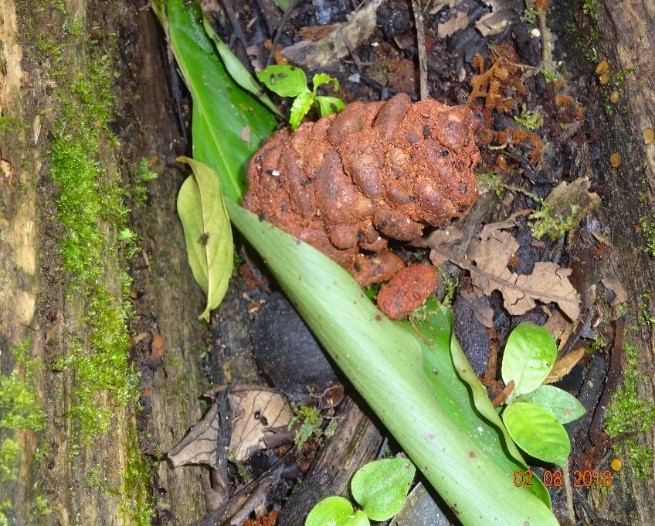
Figure 10: Chimpanzee faeces encountered in Kom-Wum Forest Reserve dominated by fruit seeds©Fotang Chefor
Monitoring medium-to-large mammals wildlife species using camera trapping in Kom-Wum Forest Reserve
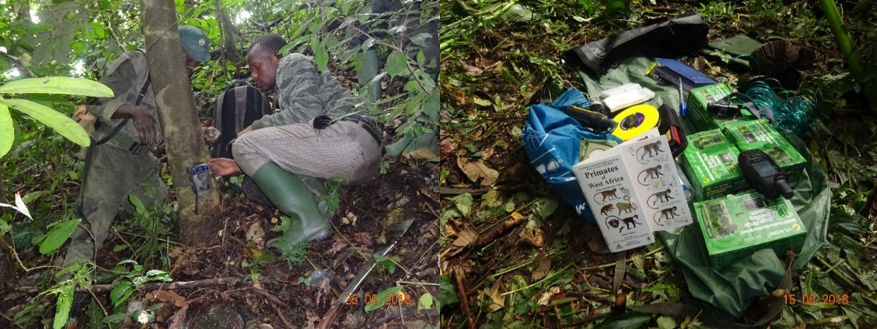
Figure 1: A PRACOND researcher and a community eco-guard install wildlife camera traps in Kom-Wum Forest Reserve, Cameroon, to monitor chimpanzees and other wildlife species (left). © Mvo Denis.
Conservation Education, Community Awareness Campaigns, and Sensitisation Meetings on Sustainable Natural Resource Use in Communities Surrounding Kom-Wum Forest Reserve
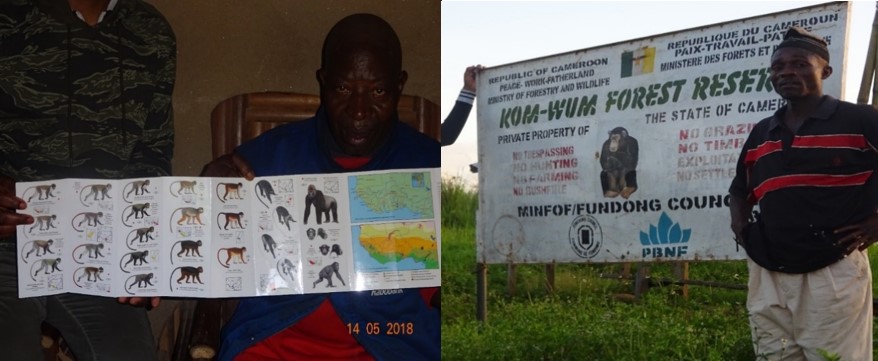
A PRACOND researcher interviews a local community member to gather information on the primate species present in Kom-Wum Forest Reserve, Cameroon, as part of a community-based wildlife conservation assessment. © Mvo Denis.